
The Gift of Pain
For those coping with pain, The Gift of Pain by Dr. Paul Brand and Philip Yancy is an excellent book. Brand and Yancey conclude that ...
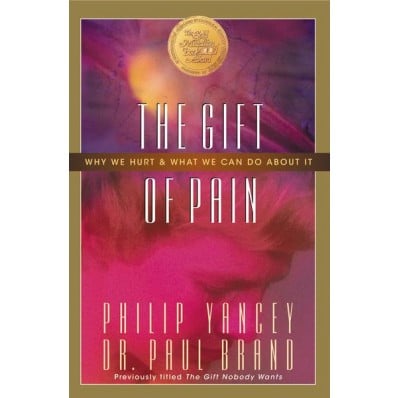
For those coping with pain, The Gift of Pain by Dr. Paul Brand and Philip Yancy is an excellent book. Brand and Yancey conclude that we need pain. The following is an excerpt from a review by Craige McMillan.
The middle of Dr. Brand’s book is a detective story. The patients that he began serving felt no pain. Because they felt no pain, his patients constantly injured themselves. Injuries seemingly never healed. Amputations resulted. The medical community had long ago written the chain of events off as part of the disease: leprosy.
But as Dr. Brand learned, a life without pain is a dangerous life,
indeed. And it is not only lepers, but diabetics, who are often
afflicted with this condition. When he came to the U.S. Public Health
Service, a project was begun to duplicate the body’s warning system of
pain. It was hoped that such a system would give these patients the same
warning sign regarding impending injury that pain provides, thus
preventing damage to the body. None was ever discovered.
It is the third section of Dr. Brand’s book that will be of the most
intense interest and use to those suffering from pain. With the
exception of the patients Dr. Brand describes, that is likely to include
most of us at some point in our lives. He writes:
“My work with pain-deprived patients has proved to me that pain protects us from destroying ourselves. Yet I also know that pain itself can destroy, as any visit to a chronic pain center will show. Unchecked pain saps physical strength and mental energy, and can come to dominate a person’s entire life. Somewhere between the two
extremes, painlessness and incessant chronic pain, most of us live out
our days.”
It is in this third section that Dr. Brand weaves together a lifetime
of medical and human knowledge about pain: how it protects us, and how
we can prevent it from overwhelming us. “What takes place in a person’s
mind is the most important aspect of pain,” he writes, “and the most
difficult to treat or even comprehend. If we can learn to handle pain at
this third stage, we will most likely succeed in keeping pain in its
proper place, as servant and not master. Pain and pleasure come to us not as opposites but as twins, strangely joined.”
Related Blogs
Talking to a killer in a Matamoros jail
Jorge was 32 years old when I visited him in a Matamoros jail. The angry bruis...

Getting Help to Typhoon Victims
Liz Ogletree is working to help get aid to those needing it in the Philippines. ...

Hover over the chaos
Chaos seems to be the state of nature. Everything loses heat and dies; then chao...
Related Races (3)
South America | Semesters | September 2027

Gap Year | Remnant | August 2027